You know how you always think you're cooler when you're drunk? Have you ever wondered whether you were really cooler, or if you were just fooled by the alcohol? I have. Pretty much every time I drink. I always wish I had some way of recording the drunk version of me, so that the sober version of me can try to figure it out.
Clearly, there's no way to make this a blind study. Unless I get blind drunk. Double-blind drunk!
Tomorrow, I will visit this post (sober) to re-evaluate how funny it is. For Science!
I fear the blind study/blind drunk joke might not hold up so well.
Thursday, April 10, 2008

Sunday, September 16, 2007
Friday, February 09, 2007
fluendo plugin installation in Fedora 6
For some reason this information is impossible to find. The first step is the same as it is elsewhere: you do a
and copy the plugin .so files in there, e.g.:
but with Fedora you also have to set the SELinux security context:
If you're curious, you can see the security context of a file like so:
mkdir ~/.gstreamer-0.10/plugins
and copy the plugin .so files in there, e.g.:
tar xjf fluendo-mp3-1.i386.tar.bz2
cp fluendo-mp3-i386/libgstflump3dec.so ~/.gstreamer-0.10/plugins/
but with Fedora you also have to set the SELinux security context:
cd ~/.gstreamer-0.10/plugins/
chcon --type=textrel_shlib_t *.so
If you're curious, you can see the security context of a file like so:
secon --file libgstflump3dec.so
Sunday, June 11, 2006
Not sexy enough
They were out of this t-shirt, so I took a picture of the sign:
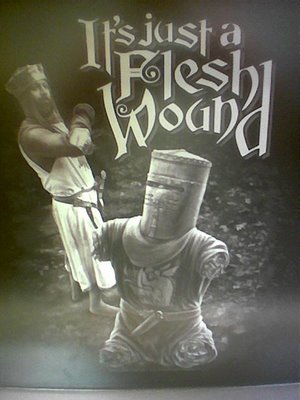
The only one they did still have was "I fart in your general direction," which didn't strike me quite the same way.
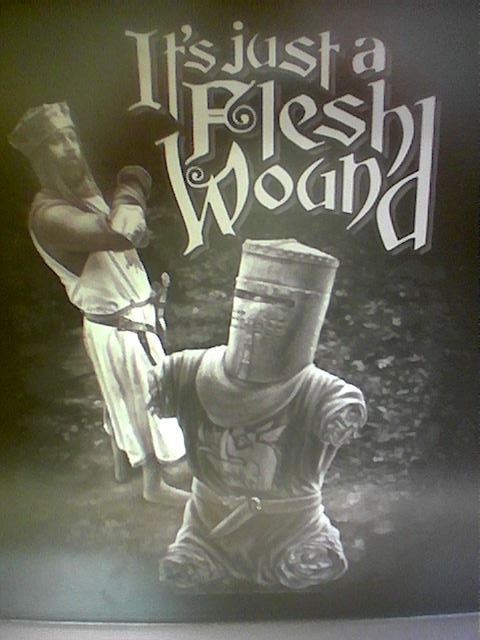
The only one they did still have was "I fart in your general direction," which didn't strike me quite the same way.
In vino, veritas
The other day, I put on some cologne, and immediately the smell brought back some memories.
Of vomiting.
Of vomiting.
Monday, May 29, 2006
for every thing (turn, turn, turn)
I've been reading blogs again lately.
When the term first became widespread, the people with blogs were the early adopters, the tech people, the nerds. And, in general, they (we) can't write for shit. I looked at some blogs, thought "ah, it's nice that it's getting so easy to publish stuff," and promptly realized that I didn't give a damn.
The fact that something is possible is boring. The early blogs were intensely boring. Boring like the hamster dance (thank you, Internet, for teaching me what "banality of evil" means). It was like, here's your chance to share all your cool shit with everyone, and you're telling me what you ate for lunch?
Things only got interesting once people started really doing stuff with those possibilities. And no, mind-numbing debates between RSS and Atom advocates do not count. Which suprises me, really, because I'm usually totally engaged in the tech stuff. REST vs. WS-*? I'm there. Software Transactional Memory? I'll actually read the damn paper. Putting Curry-Howard to work? Amazing stuff, seriously.
But now... Now! We have actual writer-type people actually writing actual interesting things. All over the place. And by "writer-type people" I don't mean people who write for a living, necessarily, I just mean people who can actually write. So yes, now, in 2006, I am finally reading personal blogs on a regular basis. There's a fair amount of good stuff out there. And this is a relatively new thing.
Sure, sure, if you're actually reading this then you probably found all this out before I did. Also, you have no life. The great thing about all of these readable personal blogs is, now it's clear that most everyone else has no life either. Even a jet-setting model with a rock star boyfriend is clearly bored and lonely, always in a strange town far from home and friends. This reassures me like you wouldn't believe.
It's just like the Internet as a whole. There was a big hype wave, then people found out that their lives weren't going to change overnight. Then it got passe to be excited about the Internet. But now is just when things are starting to get seriously cool. People just don't notice as much.
I think this is because the current change is social rather than technical. When each technical change happened, it was quick and easily identifiable; one day all of a sudden there was this concrete new thing. But the change that's happening now is when everyone actually starts to move into the building that's been waiting for them. And I'm giddy like a schoolgirl over how great the neighbors are.
Speaking of which, the blog that inspired this post.
When the term first became widespread, the people with blogs were the early adopters, the tech people, the nerds. And, in general, they (we) can't write for shit. I looked at some blogs, thought "ah, it's nice that it's getting so easy to publish stuff," and promptly realized that I didn't give a damn.
The fact that something is possible is boring. The early blogs were intensely boring. Boring like the hamster dance (thank you, Internet, for teaching me what "banality of evil" means). It was like, here's your chance to share all your cool shit with everyone, and you're telling me what you ate for lunch?
Things only got interesting once people started really doing stuff with those possibilities. And no, mind-numbing debates between RSS and Atom advocates do not count. Which suprises me, really, because I'm usually totally engaged in the tech stuff. REST vs. WS-*? I'm there. Software Transactional Memory? I'll actually read the damn paper. Putting Curry-Howard to work? Amazing stuff, seriously.
But now... Now! We have actual writer-type people actually writing actual interesting things. All over the place. And by "writer-type people" I don't mean people who write for a living, necessarily, I just mean people who can actually write. So yes, now, in 2006, I am finally reading personal blogs on a regular basis. There's a fair amount of good stuff out there. And this is a relatively new thing.
Sure, sure, if you're actually reading this then you probably found all this out before I did. Also, you have no life. The great thing about all of these readable personal blogs is, now it's clear that most everyone else has no life either. Even a jet-setting model with a rock star boyfriend is clearly bored and lonely, always in a strange town far from home and friends. This reassures me like you wouldn't believe.
It's just like the Internet as a whole. There was a big hype wave, then people found out that their lives weren't going to change overnight. Then it got passe to be excited about the Internet. But now is just when things are starting to get seriously cool. People just don't notice as much.
I think this is because the current change is social rather than technical. When each technical change happened, it was quick and easily identifiable; one day all of a sudden there was this concrete new thing. But the change that's happening now is when everyone actually starts to move into the building that's been waiting for them. And I'm giddy like a schoolgirl over how great the neighbors are.
Speaking of which, the blog that inspired this post.
Monday, May 08, 2006
Like ice, only I live on it
I have hardwood floors.
The fact that my apartment is so tiny means that the most convenient way to clean the floor is actually by hand. The first time I cleaned the floor here I had Pledge and paper towels handy, so I went with it (going with the flow is one of the secrets to bachelor housekeeping). It works okay--the fixed costs of mopping (filling the bucket, getting rid of the dirty water afterward) don't have enough floor to be amortized away. With a swiffer-like device, on the other hand, there's enough junk on my floors by the time I clean that I have to change the cloth several times, so it's not much of a win given that it's so much harder to navigate small corners. Which I have in abundance.
Anyway, I don't think Pledge is really meant for floors. For one thing, the floor is slippery for a while after you use it. Especially if you're wearing socks. Today my floor is clean but treacherous.
Clearly, someday someone is going to get blood all over my nice clean floor. And what am I going to clean that up with?
The fact that my apartment is so tiny means that the most convenient way to clean the floor is actually by hand. The first time I cleaned the floor here I had Pledge and paper towels handy, so I went with it (going with the flow is one of the secrets to bachelor housekeeping). It works okay--the fixed costs of mopping (filling the bucket, getting rid of the dirty water afterward) don't have enough floor to be amortized away. With a swiffer-like device, on the other hand, there's enough junk on my floors by the time I clean that I have to change the cloth several times, so it's not much of a win given that it's so much harder to navigate small corners. Which I have in abundance.
Anyway, I don't think Pledge is really meant for floors. For one thing, the floor is slippery for a while after you use it. Especially if you're wearing socks. Today my floor is clean but treacherous.
Clearly, someday someone is going to get blood all over my nice clean floor. And what am I going to clean that up with?
Wednesday, June 29, 2005
Apophenia
It's easy to read too much into the market. What I don't get is why people persist in doing this kind of thing:
This is what you call a true leader. Leaders do just what is in their name with the market: pull it higher.Hello, circular content-free blather. I was so hoping that the crash would have killed all these guys off, but I guess idiocy springs eternal.
Tuesday, January 11, 2005
Amazon is still cool.
Here I was, looking at some CDs on Amazon, and wondering how to be the first one on my block to appreciate the next great new bands (e.g., to see them in small clubs). Then I saw this line on the product page for a CD (Summer in Abaddon, by Pinback):
Seriously, when you have lots of data you can do some really cool shit. Like, maybe, tell the difference between cultural expression that's obscure because it's not so great, and expression that's obscure for other reasons. I don't have an obscure fetish, I swear. It's more like I feel less and less well-served by the mass-market content industry. I think there's a market out there that's looking for something different, and it's not novelty or obscurity (so much), but something that expands us--something that shows us something new about ourselves, or something that was always there but that we never properly recognized. In order for something to do that, it has to be new to you, but it's more than just novelty.
I like aggregate measures like these Amazon purchasing pattern analyses because they're easier than figuring out if a particular critic has tastes like mine or not.
Here I was, looking at some CDs on Amazon, and wondering how to be the first one on my block to appreciate the next great new bands (e.g., to see them in small clubs). Then I saw this line on the product page for a CD (Summer in Abaddon, by Pinback):
Based on customer purchases, this is the #82 Early Adopter Product in Alternative Rock.One wonders if Amazon considers one an early adopter or not.
Seriously, when you have lots of data you can do some really cool shit. Like, maybe, tell the difference between cultural expression that's obscure because it's not so great, and expression that's obscure for other reasons. I don't have an obscure fetish, I swear. It's more like I feel less and less well-served by the mass-market content industry. I think there's a market out there that's looking for something different, and it's not novelty or obscurity (so much), but something that expands us--something that shows us something new about ourselves, or something that was always there but that we never properly recognized. In order for something to do that, it has to be new to you, but it's more than just novelty.
I like aggregate measures like these Amazon purchasing pattern analyses because they're easier than figuring out if a particular critic has tastes like mine or not.
Friday, April 30, 2004
Someone's blog got linked from slashdot today, and I was reading some of his older blog entries, and came across this one:
I thought this was interesting, because:
On the other hand, I do see quite a lot of blog material that is mind-numbingly dull and self-involved. Fear of writing that kind of crap is why my blog is as sparse as it is.
I know, one of these days I actually have to stop blogging about blogging, but as it happens I'm still stuck in this stage where I have to be thinking about blogging in order to blog.
I know I haven't been posting. Would you like to hear about this brown/orange breasted sparrow or sunbird I see everyday when I go into work? I like the way he shoots itself like a rocket to the tree branch from the fence as soon as I get closer. Haven't seen him in the past week. You didn't like that, did you?
I thought this was interesting, because:
- I feel like this a lot. I certainly don't find the everyday minutiae of my life interesting, so why would anybody else?
- The sparrow bit actually was interesting. Why? I'm not sure, but I thought it was cool.
On the other hand, I do see quite a lot of blog material that is mind-numbingly dull and self-involved. Fear of writing that kind of crap is why my blog is as sparse as it is.
I know, one of these days I actually have to stop blogging about blogging, but as it happens I'm still stuck in this stage where I have to be thinking about blogging in order to blog.
Saturday, February 07, 2004
Wednesday, February 04, 2004
Wow, it's been a long time. Just now, I realized that I was thinking something that would make a good blog entry. So:
A long time ago I read someone opining that science fiction was about the time in which it's written. When I read that, I was like, "no, it's about the future, duh". Maybe some things were about their own time, like the hitchhikers Guide series was about the England of the time it was written. Those books are about society, or about some cute jokes; the sci-fi parts are just setting. But then there's SF that's fundamentally about the ideas--taking an idea and working out its implications and seeing how it would affect people. That kind of SF, I thought, bore little relation to the time in which it was written. Just the opposite, actually, with the writer trying to escape from her time and place.
Lately I've been buying lots of e-books from fictionwise.com. One of the great things about ebooks is that the format makes individual pieces of short fiction commercially viable. It's a bit like iTunes in that respect, I guess, so here's the internet punditry ca. 1997 finally coming true, what with the disaggregation and all. Anyway, I've been reading lots of short fiction from the sixties through the present, and it's becoming clearer that sci-fi really is about the time in which it's written. Even in idea-based SF, the ideas being worked out are those of the era. Stuff from the 60s and 70s is all about space travel (Heinlein, Niven, et al), then later (80s-ish) it's about computers and robots (frequently, some combination of computers and robots with space, cf Asimov). In the 90s we have a spate of stuff about genetics (recommended: Nancy Kress, "Beggars In Spain"). Nowadays, we get lots of stuff about the internet, with telepresence, virtual reality, distributed collaboration and computation, and cool shit like that (Cory Doctorow, for example). Of course there are exceptions, but the volume of stories does correspond.
Maybe this is obvious, like of course idea-based sci-fi is going to reflect the zeitgeist, because new scientific or engineering breakthroughs fire everyone's imagination in a similar way at the same time.
Apparently people don't all see the correspondence as going in that direction, though. A few years ago in college I was present for an argument between two people: fuzzy person (FP) and non-fuzzy person (NFP). FP majored in Rhetoric and Political Science, and he thought that fiction drove science and engineering. He thought that a Star Trek-style transporter was not far off. All the engineers he knew were probably Star Trek fans, and it was clear that the imagination side of things had played a role in the career choices a lot of them made. NFP was some kind of engineering major, and he disagreed, saying that science and engineering are really driven by what's possible at a particular point in time. Naturally, I sided with NFP; there's a huge number of scientific discoveries that are purely serendipitous (so much that it's a little depressing), and physics puts a pretty hard limit on what the engineers can do.
All of the sci-fi reading really put this into focus, though. In "2001" Pan Am was making commercial trips to a space station; in 2001 Pan Am was long gone and Mir burned up over the Pacific.
My point is not that SF writers get it wrong sometimes. It's worse than that. With the amount of writing going on, it seems like pure chance would have given us more validated fictional predictions than we've gotten. People like to cite how Arthur C. Clarke predicted/invented the geosynchronous satellite, but interestingly almost no-one actually remembers the story that it appeared in. The story itself was forgettable; the insight was an engineering one, and the story was a bit secondary. The sci-fi stories about space occur almost entirely outside of Earth orbit, but the real effect rocket science had on society has been through ICBMs and satellites. The robot stories focus on humanoid robots, but we don't need 'em. We've got plenty of humanoids sitting around as it is--you can hardly throw a rock without hitting one. The genetic stories are almost all about human germline genetic modifications, but it looks like genetics is going to have a really big impact in diagnosis and drug development, and as a general tool in biological research. Germline mods get done in agriculturally significant organisms (about which very little fiction is written), but it'll be a very long time before parents start putting non-human genes into their kids.
Maybe it's just that the fiction predictions are being made on much larger time scales, and they'll come true eventually even though we haven't seen it yet, but I don't think so. I think the interesting stories are a lot of the time not the ones that are actually feasible or desirable, so the scenarios in them rarely actually occur.
A long time ago I read someone opining that science fiction was about the time in which it's written. When I read that, I was like, "no, it's about the future, duh". Maybe some things were about their own time, like the hitchhikers Guide series was about the England of the time it was written. Those books are about society, or about some cute jokes; the sci-fi parts are just setting. But then there's SF that's fundamentally about the ideas--taking an idea and working out its implications and seeing how it would affect people. That kind of SF, I thought, bore little relation to the time in which it was written. Just the opposite, actually, with the writer trying to escape from her time and place.
Lately I've been buying lots of e-books from fictionwise.com. One of the great things about ebooks is that the format makes individual pieces of short fiction commercially viable. It's a bit like iTunes in that respect, I guess, so here's the internet punditry ca. 1997 finally coming true, what with the disaggregation and all. Anyway, I've been reading lots of short fiction from the sixties through the present, and it's becoming clearer that sci-fi really is about the time in which it's written. Even in idea-based SF, the ideas being worked out are those of the era. Stuff from the 60s and 70s is all about space travel (Heinlein, Niven, et al), then later (80s-ish) it's about computers and robots (frequently, some combination of computers and robots with space, cf Asimov). In the 90s we have a spate of stuff about genetics (recommended: Nancy Kress, "Beggars In Spain"). Nowadays, we get lots of stuff about the internet, with telepresence, virtual reality, distributed collaboration and computation, and cool shit like that (Cory Doctorow, for example). Of course there are exceptions, but the volume of stories does correspond.
Maybe this is obvious, like of course idea-based sci-fi is going to reflect the zeitgeist, because new scientific or engineering breakthroughs fire everyone's imagination in a similar way at the same time.
Apparently people don't all see the correspondence as going in that direction, though. A few years ago in college I was present for an argument between two people: fuzzy person (FP) and non-fuzzy person (NFP). FP majored in Rhetoric and Political Science, and he thought that fiction drove science and engineering. He thought that a Star Trek-style transporter was not far off. All the engineers he knew were probably Star Trek fans, and it was clear that the imagination side of things had played a role in the career choices a lot of them made. NFP was some kind of engineering major, and he disagreed, saying that science and engineering are really driven by what's possible at a particular point in time. Naturally, I sided with NFP; there's a huge number of scientific discoveries that are purely serendipitous (so much that it's a little depressing), and physics puts a pretty hard limit on what the engineers can do.
All of the sci-fi reading really put this into focus, though. In "2001" Pan Am was making commercial trips to a space station; in 2001 Pan Am was long gone and Mir burned up over the Pacific.
My point is not that SF writers get it wrong sometimes. It's worse than that. With the amount of writing going on, it seems like pure chance would have given us more validated fictional predictions than we've gotten. People like to cite how Arthur C. Clarke predicted/invented the geosynchronous satellite, but interestingly almost no-one actually remembers the story that it appeared in. The story itself was forgettable; the insight was an engineering one, and the story was a bit secondary. The sci-fi stories about space occur almost entirely outside of Earth orbit, but the real effect rocket science had on society has been through ICBMs and satellites. The robot stories focus on humanoid robots, but we don't need 'em. We've got plenty of humanoids sitting around as it is--you can hardly throw a rock without hitting one. The genetic stories are almost all about human germline genetic modifications, but it looks like genetics is going to have a really big impact in diagnosis and drug development, and as a general tool in biological research. Germline mods get done in agriculturally significant organisms (about which very little fiction is written), but it'll be a very long time before parents start putting non-human genes into their kids.
Maybe it's just that the fiction predictions are being made on much larger time scales, and they'll come true eventually even though we haven't seen it yet, but I don't think so. I think the interesting stories are a lot of the time not the ones that are actually feasible or desirable, so the scenarios in them rarely actually occur.
Sunday, September 14, 2003
A lot of the time, people make jokes where the joke is that what they're saying is really crazy or fucked up.
Usually, I don't get those jokes.
Really, people say all kinds of crazy, fucked up shit when they're serious, and in comparison a lot of the joke stuff is pretty tame. Usually when people make those jokes, I think for a minute, then I'll nod and say "okay...". It's weird, sure, but not any weirder than the stuff I get on a regular basis from the people I hang out with.
Maybe I need to find saner friends. That sounds like it wouldn't be as much fun, though.
Anyway, my big problem is that a lot of the time it's not too hard to imagine a plausible explanation for the crazy statement, especially if you accept that most people are not particularly sane to begin with. Including me, for what it's worth, lest you think I'm being snooty or something.
Lately, I've had the title song from Brazil running through my head again. I have to say, opting to live in a fantasy world is certainly the happiest ending the Lowry character could have had, and as time goes by the idea of that dissociation as the (heroic?) triumph seems less and less weird.
Usually, I don't get those jokes.
Really, people say all kinds of crazy, fucked up shit when they're serious, and in comparison a lot of the joke stuff is pretty tame. Usually when people make those jokes, I think for a minute, then I'll nod and say "okay...". It's weird, sure, but not any weirder than the stuff I get on a regular basis from the people I hang out with.
Maybe I need to find saner friends. That sounds like it wouldn't be as much fun, though.
Anyway, my big problem is that a lot of the time it's not too hard to imagine a plausible explanation for the crazy statement, especially if you accept that most people are not particularly sane to begin with. Including me, for what it's worth, lest you think I'm being snooty or something.
Lately, I've had the title song from Brazil running through my head again. I have to say, opting to live in a fantasy world is certainly the happiest ending the Lowry character could have had, and as time goes by the idea of that dissociation as the (heroic?) triumph seems less and less weird.
Saturday, September 13, 2003
All self expression is a lie.
A lie of omission.
Interesting mental structures (maybe all mental structures) are too complex to be accurately expressed through any medium. Any expression is therefore unfaithful in some important way to the throughts and feelings that engendered it.
Which is not to say that creativity and expression are useless or uninteresting; just that all communication is necessarily incomplete, which is incredibly frustrating. You can slave away on whatever is it you're working on, you can devote your life to your chosen artistic medium, and no one will ever feel just what you're feeling or think just what you're thinking. Despite the increasingly connected nature of our society, regardless of the number or closeness of the relationships you have, we're all still marooned on our little islands by ourselves, sending smoke signals to each other over the water.
I hate that.
A lie of omission.
Interesting mental structures (maybe all mental structures) are too complex to be accurately expressed through any medium. Any expression is therefore unfaithful in some important way to the throughts and feelings that engendered it.
Which is not to say that creativity and expression are useless or uninteresting; just that all communication is necessarily incomplete, which is incredibly frustrating. You can slave away on whatever is it you're working on, you can devote your life to your chosen artistic medium, and no one will ever feel just what you're feeling or think just what you're thinking. Despite the increasingly connected nature of our society, regardless of the number or closeness of the relationships you have, we're all still marooned on our little islands by ourselves, sending smoke signals to each other over the water.
I hate that.
Wednesday, September 10, 2003
Okay, so I haven't ended up filling the pages like I suggested, but I'm working on it. It's all about the process, dude.
Today there was the most amazing light as I was leaving work; warm late-day light filtered through heavy clouds. It felt apocalyptic; no shadows, but much yellower than normal overcast light.
Dramatic lighting makes my life feel more interesting than it is, like when just the right song comes on the radio. The kind of light we had, I half expected to stop in the middle of the street for my close up. As though they needed to film a reaction shot for something dramatic happening off camera, like an alien invasion, or the return of my arch-nemesis, or something. If I feel like I'm in a movie, then I can pretend that there's some purpose to my life; or that I can expect some plot or character development, at least. Lots of fun, but when I tell people I really like the light it they're usually pretty non-commital. Don't other poeple have emotional reactions to light/weather/atmosphere?
In other news, what do you do when your friends are really into something that you'd rather not participate in? Especially if it has become a major focus of your friendship? I used to be game, but I'm less and less inclined to join in anymore.
Today there was the most amazing light as I was leaving work; warm late-day light filtered through heavy clouds. It felt apocalyptic; no shadows, but much yellower than normal overcast light.
Dramatic lighting makes my life feel more interesting than it is, like when just the right song comes on the radio. The kind of light we had, I half expected to stop in the middle of the street for my close up. As though they needed to film a reaction shot for something dramatic happening off camera, like an alien invasion, or the return of my arch-nemesis, or something. If I feel like I'm in a movie, then I can pretend that there's some purpose to my life; or that I can expect some plot or character development, at least. Lots of fun, but when I tell people I really like the light it they're usually pretty non-commital. Don't other poeple have emotional reactions to light/weather/atmosphere?
In other news, what do you do when your friends are really into something that you'd rather not participate in? Especially if it has become a major focus of your friendship? I used to be game, but I'm less and less inclined to join in anymore.
Tuesday, August 19, 2003
Part of me thinks that writing about writing is a little too masturbatory, even for a blog, but then again it's something that I tend to think about when I'm thinking about blogging. If I'm going to go all stream-of-consciousness on you (me?) I might as well toss in everything. Toning down that personal censor is part of the point, at least for me.
Also, because I've never decided about the audience stuff, I can't decide how personal to get. If I'm going to talk about everything that's on my mind, then I probably could never actually attach my name to the thing, which I think I might like to do someday.
Also, because I've never decided about the audience stuff, I can't decide how personal to get. If I'm going to talk about everything that's on my mind, then I probably could never actually attach my name to the thing, which I think I might like to do someday.
I have such a hard time deciding what to blog and what not to blog; what's relevant or not relevant, what's interesting or not, what's worthwhile or not.
Part of my problem is that I've never decided who the audience is, exactly, or even whether I'm writing to an audience. Without that I'm rudderless as far as "relevant" or "interesting" goes. Part of why I wanted to do this was to write whatever I felt like I needed to write, but then again I haven't been doing it long enough to know when writing down a thought will help.
So, instead of erring on the side of nothing, as I have been over the last few weeks, I will err on the side of over-description for a little while to see how it feels.
Part of my problem is that I've never decided who the audience is, exactly, or even whether I'm writing to an audience. Without that I'm rudderless as far as "relevant" or "interesting" goes. Part of why I wanted to do this was to write whatever I felt like I needed to write, but then again I haven't been doing it long enough to know when writing down a thought will help.
So, instead of erring on the side of nothing, as I have been over the last few weeks, I will err on the side of over-description for a little while to see how it feels.
Tuesday, July 29, 2003
Why do people care so much about political issues?
When I first became politically aware, say, in junior high, I was very conservative. I was curious about the "other" side, though, so I went to college at Berkeley. Since then, I've felt that both sides generally have something worthwhile to say.
In politics, the answers are not clear cut. If they were, then the issues would not be contentious, and therefore they would not be political issues. What I've been wondering about lately is why people believe so strongly in one side or the other of a political issue when the "right" position is (almost by definition) unclear. I can think of a few possibilities:
Please note: "Because I'm right and they're wrong" is not a valid answer.
When I first became politically aware, say, in junior high, I was very conservative. I was curious about the "other" side, though, so I went to college at Berkeley. Since then, I've felt that both sides generally have something worthwhile to say.
In politics, the answers are not clear cut. If they were, then the issues would not be contentious, and therefore they would not be political issues. What I've been wondering about lately is why people believe so strongly in one side or the other of a political issue when the "right" position is (almost by definition) unclear. I can think of a few possibilities:
- People think they have information that other people do not have (including experiences that others have not had)
- People think they are smarter than the people on the other side (they posess understanding that others are unable to attain)
- People's interests differ, and they are trying to secure benefits for themselves or deny special benefits to others
Please note: "Because I'm right and they're wrong" is not a valid answer.
Thursday, July 24, 2003
I need to blog because all of the things floating around in my head are going to die unless I let them out somehow. That's the charter for this blog, and if it sounds conceited you shouldn't be terribly surprised because all blogging has a tendency to be. Why should you care? Damned if I know, but it can be interesting, no? Truly interesting blog entries are rare indeed, but every once in a while something pops out that's real and true and the outlet has to exist when those thoughts happen or they die. Or worse, they get old. Old thoughts are like yesterday's lunch; once the cud has been chewed over, it's time to move on.
Why make a persistent record of old thoughts then? I figure that once they've been written I don't have to keep chewing on them anymore.
Why make a persistent record of old thoughts then? I figure that once they've been written I don't have to keep chewing on them anymore.
Subscribe to:
Comments (Atom)